
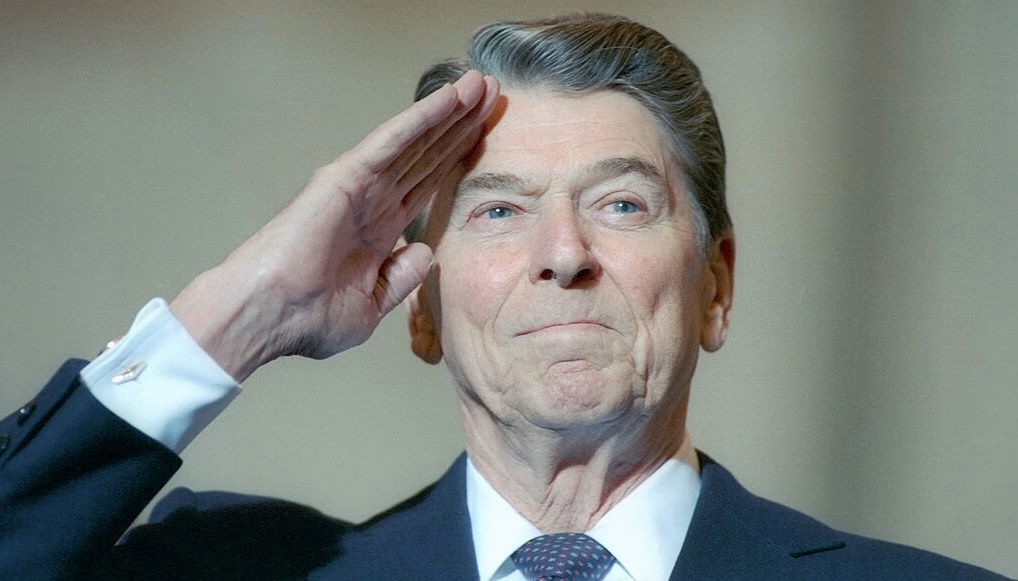

Ronald Reagan, who shifted from an enthusiastic FDR supporter in his youth to the leader of the conservative wing of the GOP, famously and repeatedly explained, ”I didn’t leave the Democratic Party. The party left me.” Having grown up as a Reagan Republican, I’m going through the process in reverse.
America’s electoral structure virtually guarantees that there will be two and only two political parties. The natural course is for both of these to be what political scientists call “catch-all” parties, each constantly shifting their political agenda to appeal to at least half the electorate. So, it’s hardly surprising that neither the Democratic nor the Republican Party are what they were when Reagan first captured the GOP nomination 36 years ago. The Democrats moved to the right on economic and national security policy with Bill Clinton in 1992 and more or less stayed there. Republicans, eventually captured by the evangelical Christians that Reagan brought into the fold, have moved further to the right on social issues while treating Reagan’s tax cut rhetoric as dogma despite having won on that issue decades ago.
As a consequence of having left the Deep South fourteen years ago and, more importantly, thirteen years of near-daily political blogging, I’ve moved somewhat left on some social and economic issues. For at least a decade, I’ve been deeply uncomfortable with aspects of the Republican Party and some of its tendencies, especially at the Congressional level. I’ve increasingly had to qualify my affiliation with modifiers that all but negated the noun, such as “Phil Gramm Republican” or “Alan Simpson Republican” or “Jon Huntsman Republican.” But I’ve been able to maintain my loyalty to the institution because, at the institutional level, it remained relatively moderate. The Establishment tended to dominate the political agenda and, more importantly, the presidential nominating process. While the Herman Cains and Mike Huckabees and Rick Santorums all had their moment in the sun, the nominating electorate always rallied behind a George W. Bush, John McCain, or Mitt Romney. It was easy to justify voting for all of them, if not enthusiastically.
That appears to be have changed this cycle. The troops did not fall in line behind Jeb Bush, Marco Rubio, John Kasich, or Chris Christie. Donald Trump, who isn’t meaningfully a Republican and seemingly has no ideological moorings, is running away with it. The scenarios for a non-Trump to win are decidedly implausible. And by far his most competitive challenger is Ted Cruz, who’s conventionally qualified but is so doctrinaire that he’s universally hated even by his own caucus in the Senate.
This isn’t a simple matter of the Establishment misreading the situation and failing to take control of it. Even if the Establishment had somehow persuaded all but Rubio–seemingly the most widely attractive of this candidates—to drop out before Iowa and consolidate their efforts, it would only have mattered at the margins (Rubio might have won Virginia yesterday, for example). All the traditional Republican candidates combined don’t add up to anything close to Trump.
Nor is it a matter of the Southern Strategy and other GOP chickens coming home to roost. At least not in the way that Democratic-leaning analysts claim. Trump isn’t the natural evolution of Reagan and Gingrich (although perhaps Cruz is). Rather, he’s a rejection of a party that has promised small government and protection of the traditional culture and failed to deliver. His message is incoherent nonsense but it resonates with voters who are fed up with the status quo.
While eight months is a long time from now, I can’t see myself voting for either Trump or Cruz, even when the alternative seems to be Hillary Clinton. At the same time, I don’t see myself going full Reagan anytime soon. While there are Democrats I could get behind, the Democratic Party just isn’t very attractive to me. Given the degree to which American politics is a team sport, I don’t know where that leaves me.









