
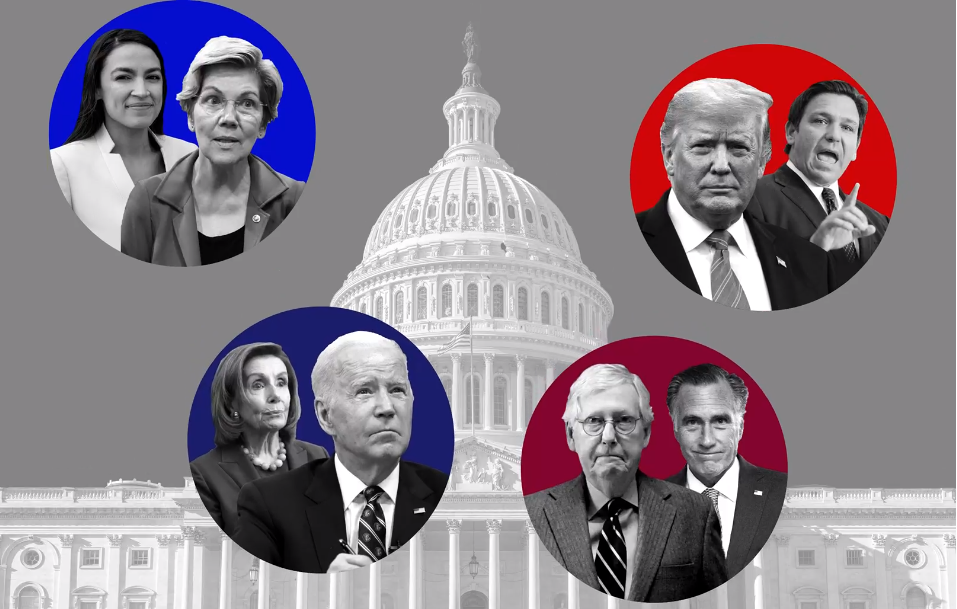

Washington Post columnist Perry Bacon Jr. argues “The U.S. has four political parties stuffed into a two-party system. That’s a big problem.”
The United States right now has four political parties stuffed into a two-party system — and that’s increasingly a big problem for the country.
This reality becomes clear if you set aside the long-standing catchall labels “Democrat” and “Republican” and look at the fissures actually animating our politics. Importantly, by “party” I’m referring to an informal group of elected officials, intellectuals and institutions with a shared ideology and policy positions. Rank-and-file voters do play some role in shaping the views of these parties, but I think the process is largely driven by political professionals.
This is a recurring theme here at OTB and, especially, in Steven Taylor’s analyses. Whether there are three, four, six, or twenty ways to divide the American polity is open to debate, as is which politicians fit into any given category. (Indeed, while I can see the justification for grouping the eight pols in the graphic above as he did, my natural inclination would be to group Nancy Pelosi into the Progressive wing; I think she’s a pragmatist only because her role as Speaker demands it.) Regardless, our electoral system essentially guarantees that there will be, at most, two electable alternatives and that most voters will not see themselves represented by either.
Indeed, Bacon agrees that the groupings as both artificial and fluid:
In 2017, immediately after Donald Trump’s election, I viewed America as having essentially four political parties, too, but the contours were different then: There were the Democrats, the anti-Trump Republicans, the Old Guard Trump-skeptical Republicans and the Trump-aligned Republicans. I thought the Old Guard represented more Republican voters and was more powerful than the Trump faction, which I believed had lucked into winning the Republican primaries and the general election.
Five years later, a different party structure has emerged. The Trump Republicans and the Old Guard remain distinct. But the Trump Party clearly has the upper hand, in part because evangelical Christian activists, Fox News and conservative talk radio are firmly rooted there, as well as influential GOP politicians including Gov. Ron DeSantis of Florida and, of course, Trump himself.
But the Old Guard, perhaps best embodied by Senate Minority Leader Mitch McConnell (R-Ky.), news outlets such as the Wall Street Journal’s editorial page and organizations such as the U.S. Chamber of Commerce, remains influential. A small bloc within the Old Guard, such as Utah Sen. Mitt Romney and Maryland Gov. Larry Hogan, isn’t just Trump-skeptical but outright anti-Trump.
I think that’s right as far as it goes but how influential are WSJ and the Chamber in the grand scheme of things? Less so than Fox News, surely. And, while I could see myself voting for Hogan, I don’t see how he has a path to the nomination.
But, again, that’s the dilemma of the system: I’m still fundamentally an Old Guard Republican but my choice is between voting for Trump (or a Trumper) or the Democrat or staying home (or voting Libertarian or some other protest vote, which is functionally the same). For all intent and purposes, I’ve become a Democrat even though I’m not particularly aligned with that party. And most Old Guard Republicans are effectively Trumpers, since that’s what the primary system delivers.
And, indeed, Bacon reaches a similar conclusion:
Meanwhile, “Never Trump” Republican activists and intellectuals have largely been absorbed into a third party, the Center-Left Democrats. This is the party of, for instance, President Biden, House Speaker Nancy Pelosi (Calif.), New York City Mayor Eric Adams, the policy group Third Way and the MSNBC show “Morning Joe.”
That’s right. But, again: that’s a function of a dearth of acceptable choices, not a natural alignment.
Finally, the surprisingly strong 2016 campaign of Sen. Bernie Sanders (I-Vt.) reignited the left wing of the Democratic Party and created our fourth party — a Left-Left Democratic Party. This party includes Sanders, Sen. Elizabeth Warren (Mass.), Rep. Alexandria Ocasio-Cortez (N.Y.), Boston Mayor Michelle Wu, the Congressional Progressive Caucus, publications such as the American Prospect and the Intercept, and groups such as the Working Families Party. My own views are closest to this group.
There is an ideological divide between the two Democratic parties, certainly, but their differences are also generational and attitudinal — the Left-Left Democrats tend to be younger, newer to politics and more confrontational with the Republicans than the Center-Left Democrats are. “Much of the divide is about approach, confrontation, urgency, as well as policy,” said Daniel Schlozman, a political scientist at Johns Hopkins University.
I think that’s largely right, although I tend to think of the Prospect as more mainstream. The Progressives were always there, of course, but years of defeat at the national level brought the New Democrats, represented by the Clintons, to dominance at the national level. Obama was to their left and, despite his being older than all of them, Biden is even further to the left. But they’re much more pragmatic and politic than the Sanders-Warren-AOC wing.
There is nothing new or inherently bad about America having a two-party system with each of those parties being internally divided. But right now, this structure is a huge problem, for three reasons.
First of all, it is empowering the Trump Republicans. Most voters are not that ideological but are quite partisan. So whoever wins a Democratic or Republican primary will have the support of the overwhelming majority of that party’s voters in a general election. That’s how Trump, whom many GOP voters were fairly wary of at first, ended up president. It’s likely Sanders, if he had won the Democratic nomination in 2016 or 2020, would have won the overwhelming majority of Democratic voters in a general election, even though many centrist party leaders were wary of him.
That makes it all too easy for Trump Republicans to gain power in our current four-parties-in-two arrangement. They simply have to win low-turnout primaries and then reap the benefits of partisanship, which vault them to victory in general elections in many places. And that’s where the biggest problem comes in. We are seeing the worst kind of governance in states such as Florida and South Dakota, where Trumpian officials have gained power and are mirroring the terrible tendencies of the former president.
Further, because the Trumpian Party is gaining strength, the Old Guard is also moving in a radical direction to compete. For example, former U.S. senator David Perdue, once a Republican in the McConnell mode, is now running as the Trump-aligned, election-results-questioning candidate for governor of Georgia. Defeated in his Senate reelection bid in 2021, Perdue correctly sees a clear path back to political power by running as the Trumpian candidate against incumbent Republican Gov. Brian Kemp, who angered many conservatives by refusing to go along with Trump’s scheme to overturn the state’s election results.
Right. But, absent the elites taking control of the party from the primary electorate, which is unlikely to happen, I don’t see a way out of this problem.
The second problem with our current structure arises on the Democratic side, where we now have two ideologically distinct blocs unhappily stuck together under the same banner. Center-Left Democrats view people with very left-wing ideas such as Rep. Cori Bush (D-Mo.) as tarnishing the party’s brand. Meanwhile, Ocasio-Cortez, who in 2020 correctly noted that she and Biden would be in different parties in many countries, regularly complains about what she describes as the lack of urgency coming from the Center-Left Democrats on major issues. This tension shows up on issue after issue, and it seems intractable.
This strikes me as a problem of a different order. Progressives are a minority of the Democratic Party and a tiny minority in the country as a whole. That they have to settle for half, or even a third, of a loaf and are frustrated by that is, well, politics. The dynamic in the GOP is far worse: it’s empowering a minority that may be even smaller than the progressives to the detriment of the country as a whole.
Third, many voters, particularly anti-Trump Republicans and people with a mishmash of views that don’t fit into one of these four groups, have fairly little representation in this structure.
Again, that’s been true of American politics forever. And, even if we eliminated primaries, enacted proportional representation, and all manner of other reforms, the views of those well outside the mainstream aren’t going to get a lot of traction in a representative system.
But, naturally, Bacon would like to try:
What can be done about these problems? Our predicament makes me long for ranked-choice voting, proportional representation, multi-member congressional districts and other ideas being pushed by political reformers. Those reforms would make it easier for candidates who aren’t Democrats or Republicans to win legislative seats, thereby hastening the creation of the true multiparty system we desperately need — and under which these four parties could be their true selves. Maybe the Center-Left Democrats and Old Guard Republicans would occasionally unite in a coalition of the moderates; perhaps the three other parties would join forces against Trumpism.
Maybe. But, as Bacon acknowledges, none of this is going to happen any time soon.
So, naturally, he gets even more fanciful:
Center-Left Democrats and Left-Left Democrats are increasingly running competing candidates in Democratic primaries, recognizing that it matters what kind of Democrat represents a given district. After Biden’s State of the Union address last week, a prominent Left-Left Democrat (Rep. Rashida Tlaib of Michigan) delivered a response laying out a more progressive vision for the country, while a more conservative Democrat, Rep. Josh Gottheimer of New Jersey, also gave separate remarks, urging Democrats to work more with the GOP.
In his Senate campaign in Utah, Evan McMullin is running as an anti-Trump independent, smartly trying to build a coalition of anti-Trump and Old Guard Republicans, Center-Left Democrats and Left-Left Democrats to win in a red state.
Similarly, the idea that was floated by some Center-Left Democrats to put Vice President Harris on the Supreme Court so that Biden could make an Old Guard Republican such as Rep. Liz Cheney (Wyo.) or Romney his No. 2 shows a laudable desire to try to build a broad coalition that can unite against the Trump Republicans. (It would, of course, be a mistake to push the first-ever woman of color out of the vice presidency.)
This sort of thing drives me nuts. Cheney and Biden have very different visions for the country. She would have very little power, indeed, in shaping policy as Vice President. And, of course, were Biden—who would be 81 at his second inauguration—not survive the term, he would be replaced by someone with a completely different domestic agenda. How would that be good for the country?










