
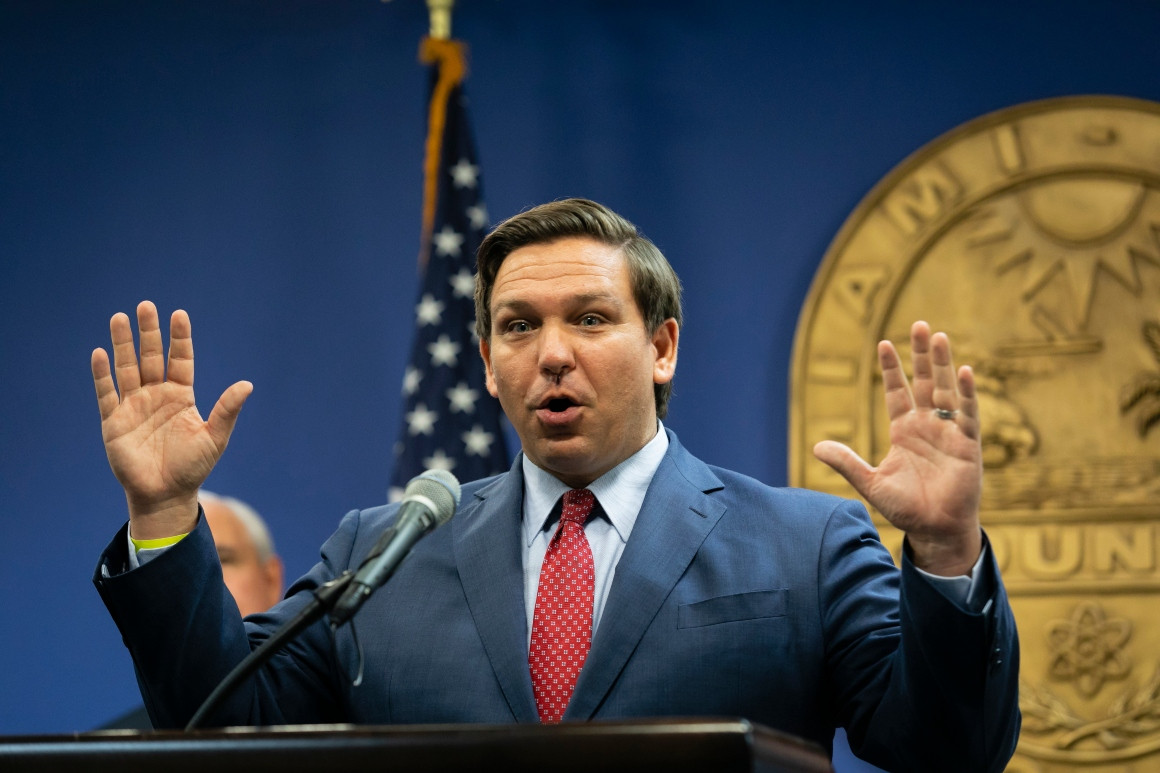

Axios (“Florida Gov. Ron DeSantis bans coronavirus ‘vaccine passports’“):
Florida Gov. Ron DeSantis issued an executive order Friday prohibiting businesses from requiring customers to show proof they have received COVID vaccines and preventing the state government from issuing so-called “vaccine passports.”
Why it matters: Immunization credentials for the coronavirus have become a controversial subject, especially with Republican governors, though proof of vaccination could speed international travel and economic reopening plans.
What they’re saying: DeSantis’ order says requiring immunization credentials “would create two classes of citizens based on vaccination.”
“Businesses in Florida are prohibited from requiring patrons or customers to provide any documentation certifying COVID-19 vaccination or post-transmission recovery to gain access to, entry upon, or service from the business,” the order states.
“It is necessary to protect the fundamental rights and privacies of Floridians and the free flow of commerce in the state.”
Businesses that do not comply with the order will be ineligible to receive state contracts or grants.
The big picture: The Biden administration has been working with private companies to create immunization credentials, and many businesses, including some in Florida, have said they’ll require proof of vaccination as part of reopening.
When Doug Mataconis emailed this story to me yesterday afternoon, I wondered where DeSantis derived the legal authority to do this. Doug is dubious as well.
The New York Times account (“Florida’s governor bans agencies and businesses from requiring ‘vaccine passports.’“) reinforces that suspicion:
Mr. DeSantis’s order is likely to draw legal challenges, raising questions about the impact of two Supreme Court decisions. In Jacobson v. Massachusetts, the high court in 1905 upheld the authority of states to enforce compulsory vaccination laws. That ruling for more than a century has let public schools require proof of vaccinations of its students, with some exceptions for religious objections.
In 2018, the Supreme Court ruled in favor of a Colorado baker who had refused to create a wedding cake for a gay couple on narrow grounds, and other courts have struggled with how to balance state laws barring discrimination against constitutional rights like free speech and the free exercise of religion. It is not clear that Florida businesses could invoke a constitutional right to refuse to comply with the new measure.
Still DeSantis is far from alone in opposing the practice.
Some other Republican governors have also come out against the passport concept. Gov. Pete Ricketts of Nebraska issued a statement Wednesday saying that the state would not participate in any vaccine passport program, and Gov. Mike Parson of Missouri told reporters Thursday that he would not require vaccine passports in the state but was also not opposed to private companies adopting them.
They are, however, swimming against the tide. While I fully understand the libertarian arguments against requiring proof of vaccination status, including the various slippery slope issues, the practicalities are rather overwhelming. As noted this morning, the CDC has finally acknowledged that fully vaccinated people should be allowed to gather in large groups, travel, and the like but, without being able to distinguish there is no way for venues to capitalize on that fact.
Walmart, last month, joined an international effort to provide standardized digital vaccination credentials to people. The company joins a push already backed by major health centers and tech companies including Microsoft, Oracle, Salesforce, Cerner, Epic Systems, the Mitre Corporation and the Mayo Clinic.
Some colleges and universities have also begun setting vaccine requirements for the next school year. Cornell University issued a statement on Friday saying that vaccinations would be required for in-person attendance in the fall, and Rutgers University in New Jersey said last week that all students would need to be fully vaccinated to be allowed to return to campus in the fall, baring religious or medical reasons.
[…]
Some venues and events in Florida had already made plans to require vaccinations. The Miami Heat basketball team said it would give prime seating to vaccinated fans. The South Beach Wine & Food Festival said it would require proof of vaccination or a negative coronavirus test to attend. Nova Southeastern University said it would mandate vaccinations for all faculty and staff members as of Aug. 1 to participate in on-campus learning.
It was not immediately clear on Friday what those businesses would do in response to the governor’s order.
My guess is that, as with Georgia’s outrageous attempts to curtail voting rights, corporate interests will prevail here over the strange interests of Republican lawmakers.









